
KI’S ARCHIVE · KYOTO
Park Hyatt Kyoto: A Different Side of Kyoto
At the start of Ninenzaka and across from Kodai-ji, Park Hyatt Kyoto keeps one of the city’s busiest neighborhoods at arm’s length. A photo-led look at how it does that.
Explore Park Hyatt Kyoto
Higashiyama, Kyoto
·
5
min read
Most of Kyoto’s famous streets come with a crowd attached. Ninenzaka and Sannenzaka, the stone-paved slopes that climb toward Kiyomizu-dera, are among the most photographed in Japan: dark timber machiya, paper lanterns, and the Yasaka Pagoda standing over the rooftops.
Park Hyatt Kyoto sits at the start of that slope in Higashiyama, directly across from Kodai-ji temple. What is unusual is how little of the neighborhood’s noise follows you through the gate.
This is a photo-led look at how that works: the street outside, the garden you cross to get in, the rooms, the table, and the bar. The hotel opened in 2019 with just 70 rooms and suites, one of the smallest in the Park Hyatt family, and the scale shows.
The street outside
The entrance is easy to miss. There is a small black sign and a gap in the wall, and nothing that announces a luxury hotel. Behind you, Ninenzaka runs on through one of the best-preserved clusters of old buildings in the city.
The first photograph below was made on a Higashiyama lane at blue hour: lanterns lit, stone pavement empty, timber facades glowing. The second looks toward the Yasaka Pagoda from above the garden and rooftops. It is the same landmark from a very different vantage point, which is really the story of this hotel.


Left: a Higashiyama lane at blue hour. Right: the Yasaka Pagoda from above the garden and rooftops.
Crossing the garden
Getting from the street to the lobby means crossing a Japanese garden first: gravel paths, clipped pines, a pond with rocks set into it, and tiled roofs tucked in behind the trees. Park Hyatt Kyoto was designed and built by Takenaka, a Japanese construction firm with roots in temple and shrine carpentry, with interiors by New York designer Tony Chi. The low-rise buildings keep the hillside’s silhouette intact.
The grounds are shared with Kyoyamato, a kaiseki restaurant that has served here since 1877, so the older buildings and the garden belong to the site’s history rather than the hotel’s.
Beyond the roofs, the hills of Kyoto sit in the background, and in the pond a heron stands still among the rocks.
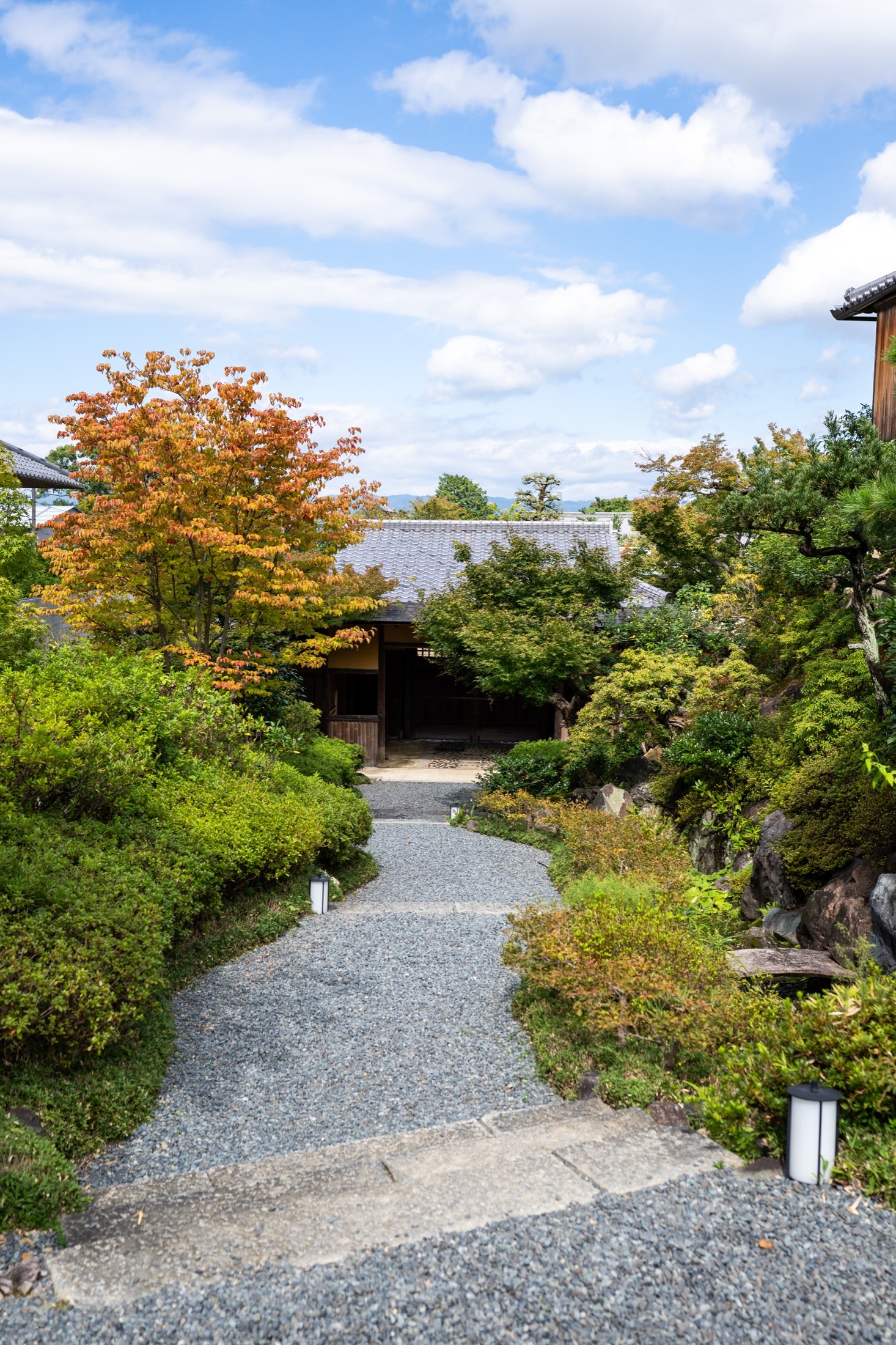
The garden path, the pond, a tiled pavilion and the moss. Swipe or use the arrows.
Rooms that look back at the city
Inside, the building stays low and warm: pale wood ceilings, shoji-style screens, textured wall coverings and big windows. With 70 rooms and suites, it feels closer to a ryokan than a tower.
The best trick is the framing. Some rooms look across Higashiyama’s black-tiled roofs, and in the one shown here a wide window opens onto the Yasaka Pagoda and the hills beyond, like a scroll hung on the wall. Other rooms face walled private gardens instead.
The bathrooms continue the theme with swirling grey granite, a deep soaking tub and a waterfall spout.

A room with the Yasaka Pagoda in the window, the bed, the granite bathroom and the soaking tub.
At the table
Food is a big part of the sense of place here. The hotel has Kyoyamato for kaiseki, a teppanyaki counter at Yasaka that looks out toward the pagoda, and Kyoto Bistro for something more casual, which serves both a breakfast buffet and a traditional Japanese breakfast.
The photographs below are about color and material: a lacquered breakfast set with a clay pot of rice, a caviar-topped croquette on ribbed glass, and wagyu beside wasabi and salt on a dark ceramic plate, all set against warm wood.

A Japanese breakfast set, then two courses from the counter.
The bar
Kohaku, the hotel’s bar, sits next to Yasaka and focuses on whisky, sake and gin, including bottles from Kyoto-based makers. The frames below come from a long wooden bar counter lined with deep red leather seats, with greenery in the windows.
A green cocktail topped with a flower, a bartender stirring a deep red drink in an etched mixing glass, and a second red cocktail on the counter.

Drinks at the bar.
The quieter side of Kyoto
Higashiyama is ringed with temples, and the hotel’s concierge can arrange experiences around them. The hotel lists an exclusive Kiyomizu-dera tour for stay guests that ends with Ajikan, a meditation practice, as well as tea at Soyotei, an Edo-era teahouse on the grounds.
The two portraits below show a monk in a tatami room that opens onto a moss garden, the kind of stillness that sits just beyond the lane outside.


A monk in a tatami room that opens onto a moss garden.
Final thoughts
Park Hyatt Kyoto is not trying to be the loudest luxury hotel in a city full of them. Its case is placement and restraint: a gate on one of Kyoto’s busiest slopes, a garden that slows you down, and rooms that frame the neighborhood instead of competing with it.
It makes the most sense if you want to be close to Kiyomizu-dera, Kodai-ji and Gion without staying inside the crowd. If you want a resort-style pool, know that there is not one: the hotel’s wellness space is a Japanese-style bathhouse with a sauna, steam room and plunge pools.
If you read my take on Park Hyatt Tokyo, the contrast is the interesting part. Tokyo is a high-rise that kept its 1990s residential calm; Kyoto is a low-rise that disappears into a historic district. Both are about restraint, in very different cities.
Plan your stay
Rates, availability and rooms are on the hotel’s official page.
Explore Park Hyatt Kyoto

Keep Reading

Guide
Photographing Holi in India
Three days inside Holi in Barsana and Nandgaon: what happened, how I photographed it, and what I'd want to know before going back.

Dispatch
China: Dunhuang
Ten days deep in the Gobi Desert, chasing the Silk Road through Dunhuang's caves and dunes.

Dispatch
I Took a 14-Hour Soviet Sleeper Train From Romania to Moldova
A 45-minute flight would have been easier. I chose the 14-hour overnight train instead. The one where they lift the entire train off its wheels at the border.
Keep Up With The Archive
New films, places, field notes and the occasional trip worth getting on a plane for.
No spam. Unsubscribe anytime.